
What Is Vibe Coding?
Key Takeaway: Software development is shifting from writing every line of code to defining goals, designing systems, and orchestrating AI agents. The developer's most valuable skill is no longer syntax mastery — it's the ability to specify what should be built, verify that it works correctly, and take responsibility for the result.
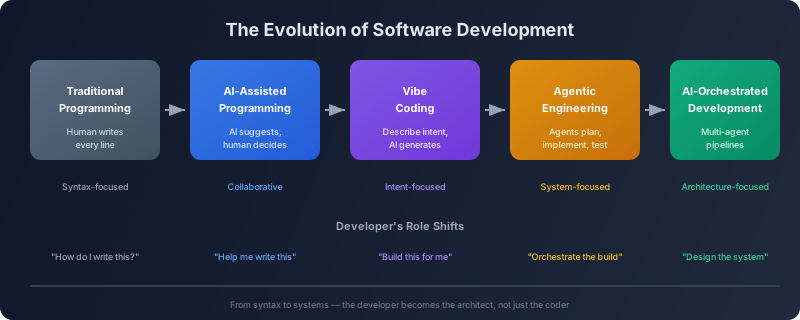
Something fundamental is changing in how software gets built. It's not just that AI can autocomplete your next line — it's that entire development workflows are being restructured around AI systems that can plan, implement, test, and iterate.
The shift runs deeper than any single tool. The way developers think about their role is changing: from writing syntax to defining intent, from implementing features to orchestrating agents, from testing individual functions to verifying entire systems.
What Is Vibe Coding?
The term "vibe coding" was coined by Andrej Karpathy — co-founder of OpenAI and former AI leader at Tesla — in February 2025. He described it as a style of programming where you "fully give in to the vibes, embrace exponentials, and forget that the code even exists." By March 2025, Merriam-Webster had listed the term. By July 2025, the Wall Street Journal reported it was being adopted by professional engineers for commercial work.
In practice, vibe coding means describing what you want in natural language, letting an AI generate the implementation, reviewing the result, and iterating through conversation. The developer focuses on intent rather than syntax.
It's important to be precise about what this means. Programmer Simon Willison drew a useful distinction: "If an LLM wrote every line of your code, but you've reviewed, tested, and understood it all, that's not vibe coding — that's using an LLM as a typing assistant." The key to the definition is less about who writes the code and more about how much the developer understands and verifies it.
Vibe coding is excellent for rapid prototyping, personal tools, and experimentation. But for production systems, it needs to evolve into disciplined engineering.
Why Vibe Coding Became Important
Recent advances in AI coding systems have made vibe coding practical in ways that weren't possible two years ago:
- Stronger coding models — models like Claude, GPT-4o, and DeepSeek produce high-quality code across many languages
- Large context windows — agents can understand entire repositories, not just isolated snippets
- Multi-file editing — AI can modify related files across a project simultaneously
- Terminal and tool access — agents can run commands, execute tests, and interact with development tools
- Debugging loops — agents can identify test failures and iteratively fix them
- Git integration — agents can commit changes with meaningful messages and manage branches
The critical difference is between autocomplete (suggesting the next token) and agentic coding (reasoning across a project and performing multi-step tasks). When a system can read your repository, understand its structure, plan changes across multiple files, implement them, run tests, and fix failures — that's a fundamentally different capability from tab-completion.
From Vibe Coding to Agentic AI
Vibe coding is conversational: you describe what you want, the AI generates code, you review it. Agentic development is autonomous: you define a goal, and an AI agent plans, implements, tests, debugs, and reports back.

Current coding agents demonstrate this shift in practice:
- Claude Code (Anthropic) — a terminal-based agentic tool that reads your codebase, executes commands, and handles git workflows through natural language
- Aider — an open-source pair programming tool that maps your entire codebase, integrates with git, and connects to any LLM
- OpenHands (formerly OpenDevin) — an open-source platform that runs agents locally or in Docker, with an "Agent Canvas" for automations
- Devin (Cognition) — a fully autonomous AI software engineer that plans and executes complex tasks in a sandboxed environment
- SWE-agent — a research tool from Princeton and Stanford that autonomously fixes GitHub issues, achieving state-of-the-art results on SWE-bench
- DeepSeek Harness — an open-source agent harness with a plugin-based architecture for extensible coding workflows
Each of these tools represents a different point on the spectrum from conversational assistance to autonomous execution. Together, they're redefining what "writing software" means.
What Changes for Developers?
The developer skill stack is being rebalanced. Some skills are becoming less central; others are becoming more important:
Decreasing emphasis: manually writing boilerplate, memorizing syntax for every API, implementing standard patterns from scratch, spending hours on repetitive refactoring.
Increasing emphasis: requirements engineering, system architecture, API design, database design, testing strategy, security analysis, code review, observability, performance engineering, and AI agent orchestration.
The key insight is this: the better AI becomes at generating code, the more important it becomes for developers to understand whether that code is correct. The scarce skill is not writing — it's knowing what to write and verifying that what was written works.
From Prompt Engineering to System Orchestration
The way developers interact with AI is itself evolving through distinct stages:
- Prompt Engineering — crafting the right instruction to get useful output from an AI model
- Context Engineering — providing the AI with relevant project context, documentation, and constraints so it produces accurate, project-specific code
- Agent Orchestration — directing AI agents through multi-step workflows: planning, implementation, testing, and iteration
- System Design — architecting entire systems where AI agents handle implementation while humans define requirements, constraints, and verification criteria
A practical example: instead of prompting "Write a Python API," a well-engineered instruction defines the database schema, endpoint contracts, authentication requirements, rate limiting, error handling, test coverage targets, and deployment environment. Then an AI coding agent can execute the full implementation workflow rather than producing a disconnected snippet.
Practical Workflow for Developers
Here's a concrete workflow that works today with current coding agents:
- Define the problem clearly
- Write requirements and acceptance criteria
- Design the architecture
- Give the AI agent project context and constraints
- Break the work into small, verifiable tasks
- Let the agent implement each task
- Run automated tests
- Review generated code — never accept it blindly
- Perform security review
- Test edge cases
- Refactor where needed
- Commit to Git with meaningful messages
- Deploy and monitor
Never accept AI-generated code merely because it runs. A function that passes basic tests can still contain security vulnerabilities, race conditions, memory leaks, or incorrect edge-case handling. The developer's judgment remains the final quality gate.
Example: Building a Real Feature
Consider adding a user authentication system to a web application.
Traditional approach: The developer manually designs the database schema, writes the PHP login endpoint, implements session management, creates the JavaScript frontend form, writes integration tests, and debugs issues over several days.
AI-assisted approach: The developer describes the feature to an AI assistant. The AI generates the implementation. The developer reviews and adjusts.
Agentic approach: The developer defines the goal ("implement secure email/password authentication with bcrypt hashing, session tokens, rate limiting, and CSRF protection"), provides architecture constraints, and lets an agent analyze the repository, plan the implementation, modify multiple files, run tests, fix failures, and report the changes. The developer reviews the complete implementation, performs a security audit, and approves the merge.
The agentic approach doesn't eliminate work — it shifts it from implementation to specification, review, and verification.
Risks of Vibe Coding
Vibe coding carries real risks when used carelessly:
- Hallucinated APIs — AI can confidently generate calls to functions that don't exist
- Insecure code — generated code may contain SQL injection, XSS, or authentication bypass vulnerabilities
- Hidden bugs — code that runs in simple tests can fail under real-world conditions
- Technical debt — rapid generation without review creates unmaintainable codebases
- Over-reliance — developers may lose the ability to debug or understand the systems they ship
- Privacy concerns — code and data sent to cloud AI services may expose sensitive information
Vibe coding is powerful for prototyping and personal projects. For production systems, it must be paired with engineering discipline: code review, testing, security auditing, and architectural oversight.
The New Developer Skill Stack
| Traditional Skill | Emerging Complement |
|---|---|
| Programming | AI-assisted programming |
| Debugging | AI-assisted debugging + verification |
| Coding | AI agent orchestration |
| Architecture | AI-aware architecture design |
| Testing | AI-generated + human-designed tests |
| Documentation | AI-assisted documentation |
| Code Review | AI + human review |
| Deployment | Agentic DevOps |
The goal isn't to replace engineering skills — it's to amplify them. A developer who understands systems, security, and architecture can direct AI agents far more effectively than someone who only knows prompts.
Advice for Students
If you're learning to code today, here's a practical roadmap:
- Beginner: Learn programming fundamentals — variables, control flow, data structures, functions
- Intermediate: Learn Git, testing, databases, APIs, and software engineering principles
- Advanced: Learn system architecture, cloud, security, and design patterns
- AI-era developer: Learn how LLMs work, how to use coding agents effectively, how to evaluate AI-generated code, and how to orchestrate multi-agent workflows
The core principle: use AI to accelerate learning and development, not to avoid understanding. A student who uses AI to skip learning algorithms hasn't learned algorithms — they've just delayed the inevitable reckoning.
The Near Future
Several trends are already visible and likely to intensify:
- AI-native IDEs — development environments designed around AI agents from the ground up, not bolted on as extensions
- Repository-level agents — systems that understand entire codebases and can maintain them over time
- Autonomous testing — agents that generate test suites, identify coverage gaps, and continuously validate code
- Multi-agent workflows — specialized agents handling planning, implementation, testing, security, and documentation
- Natural-language specifications — requirements written in plain English that agents can execute directly
It's worth distinguishing between what's happening now and what's speculative. AI coding agents already work today for real development tasks. Multi-agent pipelines are emerging. Fully autonomous software development remains limited and requires significant human oversight.
Conclusion
The future of programming isn't simply "AI writes all the code." Software engineering is moving toward a model where humans define goals, constraints, and architecture while AI systems increasingly handle implementation, iteration, and parts of verification.
The valuable developer isn't merely the person who can write syntax fastest. It's the person who can understand the problem, design the system, guide AI, integrate components, verify results, secure the system, and take responsibility for the final software.
Vibe coding opened the door. Agentic AI is walking through it. The developers who thrive will be those who learn to orchestrate rather than just implement.
Key Takeaways
- Vibe coding — describing intent in natural language and letting AI generate code — is a real and growing practice, coined by Andrej Karpathy in 2025
- Agentic AI goes further: agents can plan, implement, test, and debug across entire repositories autonomously
- The developer's role is shifting from syntax writer to system architect and AI orchestrator
- Programming fundamentals remain essential — the better AI gets at generating code, the more important it is to verify correctness
- Current coding agents (Claude Code, Aider, OpenHands, Devin, SWE-agent) already support real multi-step development workflows
- For production systems, AI-generated code must be reviewed, tested, and audited — never accepted blindly
Further Reading
- The Future of Computer Programming in the Era of LLMs and Agentic AI — our previous deep dive on how programming is evolving
- AI Coding Agents Compared — a practical comparison of Claude Code, DeepSeek Harness, OpenCode, Aider, and more
- BestWordz Developer Tools — put these ideas into practice with our free online tools
- BestWordz Community — discuss AI coding agents and software engineering with other developers
Official Sources
💬 Discuss this topic
Have questions or insights about What Is Vibe Coding?? Join the BestWordz Community.
📚 Related Articles
Introduction
Computer programming is undergoing its most significant transformation since the invention of high-…
CybersecurityFrom Prompt Crafting to System Design
Key Takeaway --> 🎯 Context engineering is the skill of designing what an AI system knows, s…
CybersecurityThe 10-Stage CS Learning Roadmap
A computer science education in 2026 requires more than traditional coursework. Today's students ne…
CybersecurityWhat Is Prompt Engineering?
Key Takeaway Prompt Engineering is the skill of communicating effectively with AI models. It is not…
CybersecurityIs AI-Generated Code Secure? A Developer Security Checklist
Key Takeaway AI-generated code is not automatically secure. LLMs produce syntactically …
CybersecuritySecrets Management for Developers: From .env Files to Secret Managers
KEY TAKEAWAY Secrets management is the practice of storing, accessing, rotating and revoking cred…
🔧 Related Tools
Base64 Decoder
Encode and decode Base64 data, entirely in your browser.
Try it now →Base64 Encoder
Encode and decode Base64 data, entirely in your browser.
Try it now →Base64URL Decoder
Encode and decode Base64URL data, entirely in your browser.
Try it now →Base64URL Encoder
Encode and decode Base64URL data, entirely in your browser.
Try it now →💬 Discuss on BestWordz Community
Join the conversation about Python, JavaScript, Docker on the BestWordz Community forum.
Visit Forum →